What to know before you order your wedding cake


Most of what determines whether your cake works is decided before anyone talks about flavour. How many portions you actually need, when you book, and who is told what happens to the leftovers. Four cake makers on the parts couples usually find out too late.
Cater for about 80% of your guests if the cake is served in the evening, not 100%. An evening finger portion is roughly one inch wide; a dessert portion is double that. Book twelve months ahead for an April to September wedding, three to six months outside peak season, and expect a booking fee of £100 to £150 with the balance due four to eight weeks before.
- Order for 80% of guests, not all of them. Not everyone takes a slice at an evening buffet.
- A finger portion is about one inch wide. A dessert portion is twice that, so the same cake feeds half as many.
- Peak season is April to September and books roughly a year out. Off-peak you have far more room.
- Tell your venue and your cake maker what should happen to leftovers, in writing, or it may be binned.
- Cake tastes better a couple of days after baking. Fresh from the oven is not the goal.
How much cake do you actually need?
This is where couples over-order, and the fix is two numbers.
"The portion sizes a couple should plan for will depend on whether they're offering their cake as a dessert option or as part of their evening buffet," says Louise Hayes Cake Design. "A dessert portion would be 2 inches wide, as opposed to a finger portion or coffee portion served with an evening buffet, which would be about 1 inch wide."
So the same cake feeds roughly half as many people if you're serving it as pudding. Decide which you're doing before you decide how big it is.
Then the part that saves money. "I recommend couples cater, if they're serving their cake at the evening buffet, for about 80% of their guest numbers," Louise Hayes adds. "So if you've got 100 guests, you want a cake that will serve about 80 portions, generally, because not everyone will have a slice."
Valeria Dolci Cakes describes the finger portion in more detail, and makes a point about flavour worth knowing. "It's roughly about 1 inch by 1 inch and around 4 to 5 inches tall, depending on the tier design. It's the ideal size for guests to enjoy with a drink, and it can even be cut in half to create two smaller bite-sized pieces. That works beautifully when the cake includes several flavours, as guests can try more than one."
If you want people to taste more than one tier, smaller slices are a feature rather than a compromise.
If you've got 100 guests, you want a cake that will serve about 80 portions. Not everyone will have a slice.
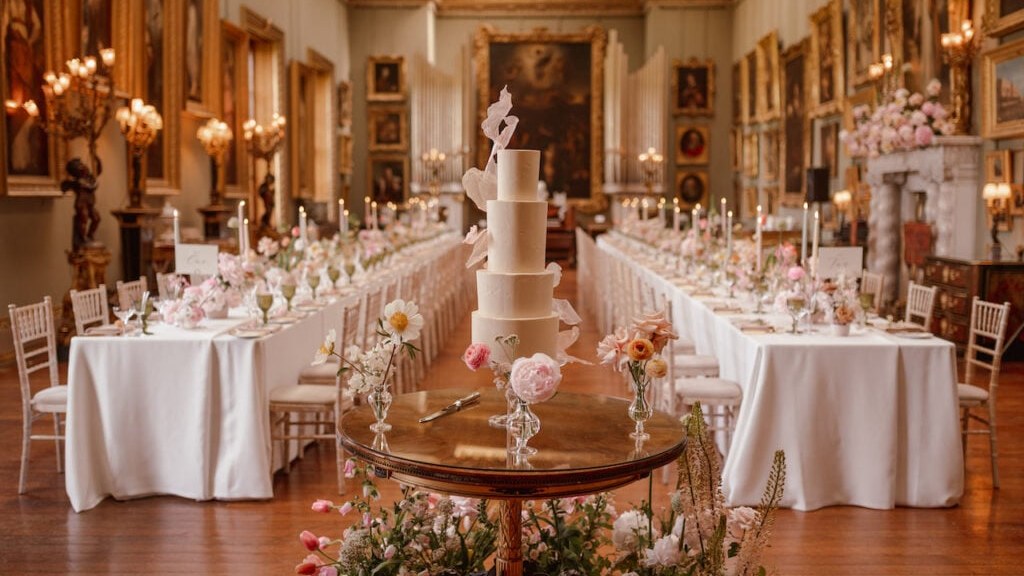
When should you book?
The honest answer is that it depends almost entirely on the month you're getting married.
"This very much depends on the time of year," says Louise Hayes Cake Design. "I would advise any couple getting married in a peak wedding season, which is roughly April through to September, to book their wedding cake a year before. Using myself as an example, I work alone and work on quite detailed, time-consuming designs. Once I have a wedding cake booked in my diary, that whole week before that wedding is blocked out to work on that order."
That's the mechanism, and it's easy to miss. A single cake can occupy a whole week of a one-person studio, so the constraint isn't oven time, it's the calendar.
"Outside of peak wedding season there's a little bit more flexibility, as cake makers' order books don't tend to be as busy," she adds, putting the off-peak figure at three to six months.
Valeria Dolci Cakes recommends nine to twelve months for anything detailed. "This allows the creative process to unfold thoughtfully, for example sugar flowers and sculptural elements. Booking 6 months ahead can still work well, particularly if the vision is already well-defined."
Sugar Plum Bakes is the most flexible of the three, and still draws a line. "Personally I prefer to have couples book somewhere between six to 12 months ahead. Although I am able to take bookings that are as little as six weeks in advance."
What do the payments look like?
Small booking fee, balance well before the day. The pattern is consistent across all three.
"It's very common for a booking fee to be required in order to secure the wedding date," says Valeria Dolci Cakes. "In my case, I ask for a non-refundable £150 booking fee, which is payable within 10 days of providing the quote. The remaining balance is then due 6 weeks before the wedding date."
"Typically wedding cake makers ask for a £100 booking fee to secure your date," says Louise Hayes Cake Design. "Some may ask for more, especially if it is a large value order, because it will take longer to make and that cake maker will have to block a bigger period of time out of their calendar. Final balances, typically 1 to 2 months before the date."
Sugar Plum Bakes explains why the balance lands early rather than on the day. "I've heard feedback from both couples and from wedding planners that couples prefer not to be getting caught up with making final payments in those last few weeks before their wedding day, as they are busy focusing on other things. They would rather have all the payments done and dusted sooner rather than later."
Cakes actually do taste better when they are 2 to 3 days old, as the flavour has a chance to develop.
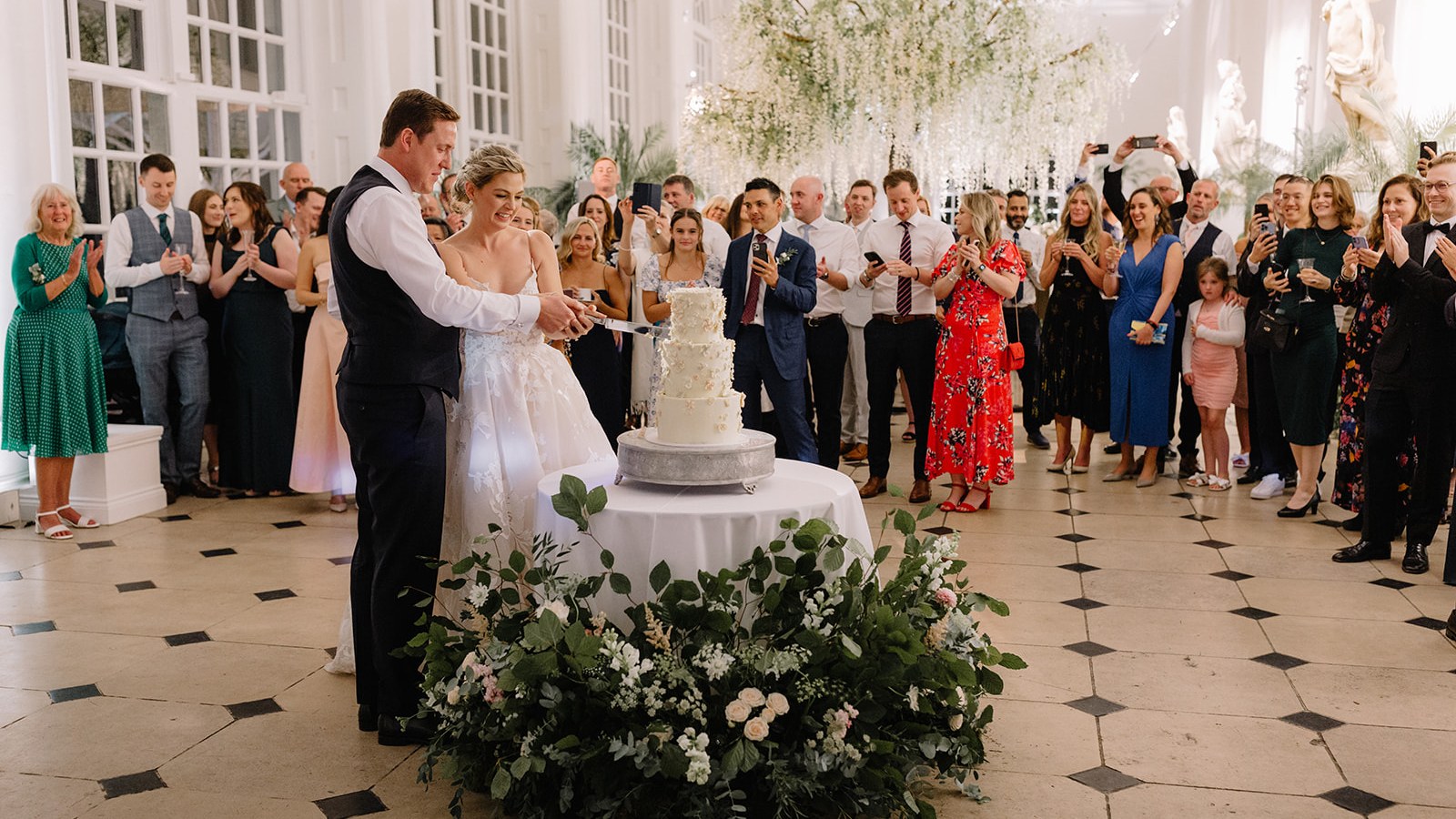
Do you get a tasting?
Yes, and it's worth asking when it happens relative to booking, because the answer varies.
"The cake tastings are typically included once the booking fee has been received," says Valeria Dolci Cakes. "I send a carefully curated tasting box by post featuring a selection of my most popular flavours."
Louise Hayes Cake Design does it the other way round, and gives a reason that's hard to argue with. "I encourage all of my couples that enquire with me to order a tasting box before they book me, because it's really important to me that they like my flavour combinations and the quality of my bakes."
She also frames why it matters at all. "Cakes don't typically represent a huge percentage of your wedding budget, but it's probably the most money you will ever spend on a cake."
Sugar Plum Bakes adds the comparison that makes the point. Supermarket cakes are a known quantity with an established brand behind them, so nobody feels the need to try one first. With a small business, the tasting is how you find out.
What happens to the cake you don't eat?
This is the one that genuinely catches people out, and it costs nothing to fix.
"Some venues will put it to one side for the couple and liaise with them during the day," says Louise Hayes Cake Design. "Other venues may unfortunately discard the cake if they haven't been given any specific instructions."
Her advice is to say what you want in advance, to both parties. "If the couple do want to do anything specific with leftover cake, such as put it into individual boxes for guests to take away, or box it up for the couple to take home the day after, then let your venue and your cake maker know. As a cake maker, I provide a handover sheet to the venue."
Keeping the top tier is still common and still works. "It's quite common for couples to reserve the top tier, or sometimes a small replica of it, to keep for their first anniversary," says Valeria Dolci Cakes. "In those cases I provide suitable packaging and guidance on how to store it correctly."
Some venues may unfortunately discard the cake if they haven't been given any specific instructions.
Frequently asked questions
Will my cake survive a hot day?
Usually, because of what's underneath the icing. "Most cake makers now use ganache, which is very weatherproof no matter what the outside coating is," says Sugar & Stories, who switches to dark chocolate ganache in extreme heat and sometimes delivers closer to the cutting time.
How fresh should a wedding cake be?
Less fresh than you'd think. "Cakes actually do taste better when they are 2 to 3 days old, as the flavour has a chance to develop," says Sugar Plum Bakes. Some makers freeze theirs after baking, believing it improves the flavour.
Do we need to provide a cake stand?
Check with all three of your venue, caterer and cake maker. Venues often have one included, though makers note they tend to be traditional silver, which may not suit a modern design. Most cake makers hire stands that match their own style.
What are the red flags when booking?
No contract and no booking fee, says Louise Hayes Cake Design, because both protect you as much as the maker. Too few reviews, or poor ones. And a business running on social media alone with no active website.
Who cuts and serves it?
Your venue or caterer, generally, and they'll usually supply the knife. Cake makers hire out stands rather than serving equipment, so confirm the cutting arrangement with whoever is running your evening.
- Cake is one of the few wedding decisions where the money and the maths are genuinely simple once someone tells you the numbers. Eighty per cent of your guests, one inch or two depending on when it's served, a year ahead if you're marrying in summer, and a sentence to your venue about the leftovers.
- Everything after that is flavour, which is the part you were looking forward to anyway.